
TKC-AGVAGV / AMRFM DS 7-39 Reference

TKC-AGV
Fire-Resistant Charging Bay
for Automated Guided Vehicles

A separate charging-safety enclosure solution for automated factories. It is intended to help confine abnormalities during lithium-powered equipment charging within a distinct, monitored, isolatable, and controllable safety space.
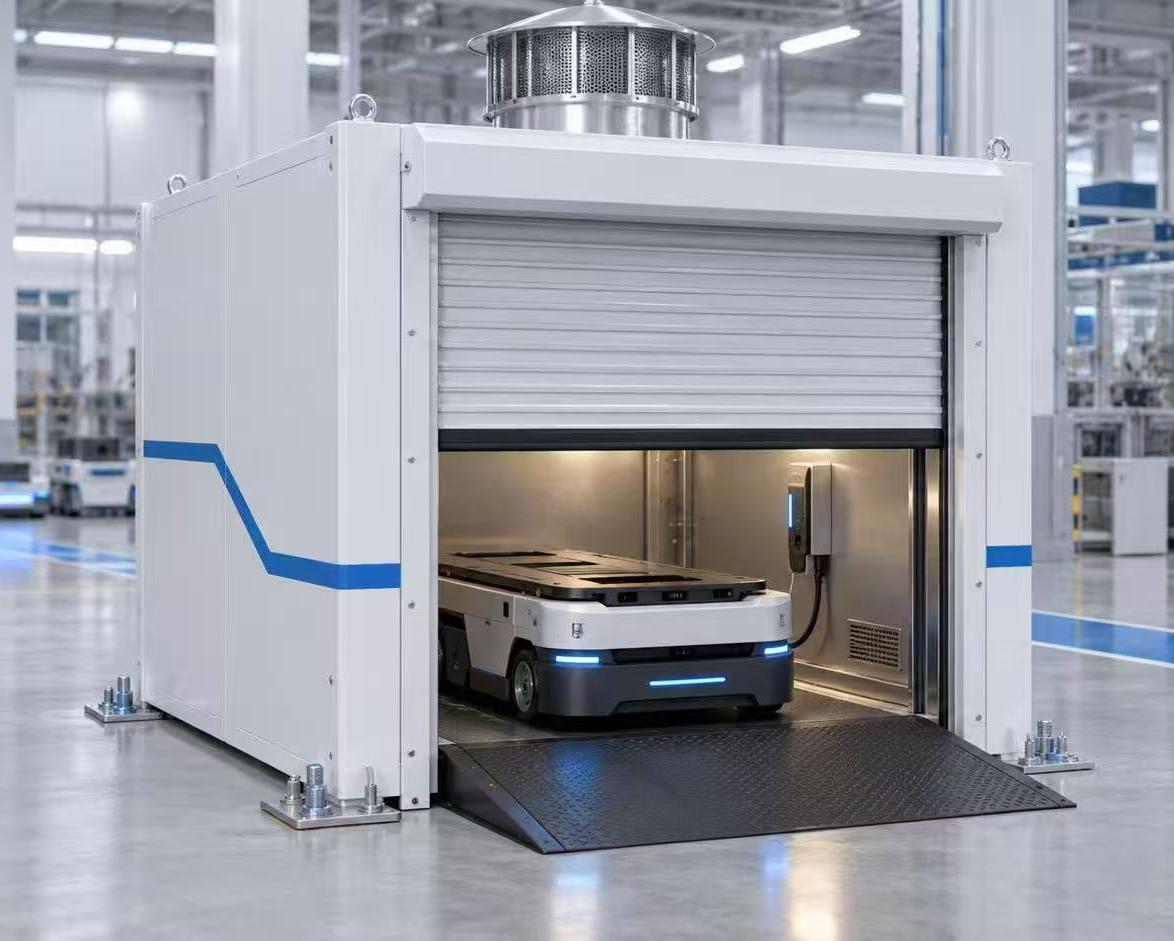
TKC-AGV fire-resistant charging bay reference image
Reference image from the technical brief
Product Positioning

A Separate, Monitored, and Isolatable Charging Safety Space

TKC-AGV is not a single fire-protection device. It is a modular safety enclosure system developed for automated lithium-powered equipment charging scenarios.

Its design objective is to detect early, isolate quickly, control escalation, prevent instability, and support production continuity. Ultra-early warning, energy isolation, fire separation, automatic suppression, and structural restraint support local risk control for charging abnormalities.

System boundary: The final configuration, standards applicability, and acceptance requirements for TKC-AGV must be confirmed against the project location, operating environment, final design conditions, and authority/insurer requirements. FM DS 7-39 and FM DS 5-1 are risk-control references on this page, not product-certification claims.
Core Product Features

An Independent Risk-Control Unit for Charging Operations

01

Ultra-Early Warning

Recognize abnormal battery off-gassing to create more response time.

02

Energy Isolation

Interlock to disconnect charging power after an abnormal condition, reducing continuing energy input.

03

Fire Separation

A fire-interlocked shutter forms an independent separation in a fire condition.

04

Automatic Response

Detection, power isolation, shutter closure, suppression, and feedback form a closed loop.

05

Structural Restraint

Floor anchoring and secondary restraint help reduce whole-unit displacement risk.

Operating Logic

From Early Recognition to Local Isolation

Ultra-early recognition → rapid energy isolation → independent fire separation → automatic response → structural restraint

01

Normal Operation

Vehicles enter and leave freely while the system monitors continuously and the shutter remains open.

02

Early Abnormal Condition

The system recognizes abnormal off-gassing, outputs an interlock signal, and enters safety standby.

03

Fire Condition

After smoke and temperature confirmation, the shutter closes and the suppression system is interlocked to act.

Main Functional Modules

Functional Configuration Organized Around Customer Value

01

Safety Enclosure

  • Fire-resistant enclosure structure
  • Impact-resistant lining
  • Fire-interlocked rolling shutter
02

Monitoring & Control

  • Lithium-battery ultra-early warning
  • Smoke and temperature fire detection
  • System control panel
03

Incident Response

  • Emergency disconnection of charging power
  • Automatic fire suppression
  • Interlock feedback
04

Structural Safety

  • Floor structural anchoring
  • Secondary restraint
  • Vehicle access ramp
Applications

For Automated Logistics, Smart Warehousing, and High-Value Production Areas

Suitable for lithium-powered equipment charging scenarios that need independent fire separation, early warning, and localized risk control.

AGV / AMR charging areas
Four-way shuttles
ASRS automated warehouses
Smart manufacturing plants
Electronics and semiconductors
Food and consumer-goods factories
Unmanned logistics systems
High-value equipment areas
Customer Value

One Safety-Enclosure Framework for EHS, Operations, and Engineering

EHS Risk Management

  • Improve charging-area risk isolation
  • Recognize battery abnormalities earlier
  • Strengthen fire-interlock control
  • Reduce the risk of single-point incident escalation

Operational Continuity

  • Support unmanned logistics operation
  • Reduce abnormal-event impact on main production lines
  • Reduce shutdown risk
  • Improve critical-facility resilience

Engineering Delivery

  • Modular design
  • Factory prefabrication
  • Controllable on-site installation period
  • Customizable for equipment dimensions
Standards & Technical Framework

Design References to Be Confirmed Project by Project

Chinese standards

GB 14102.1-2024; GB 14102.2-2024; GB 14102.3-2024; GB/T 9978.1-2008; GB 50116-2013; GB 50205-2020

FM risk-control references

FM DS 7-39 Material Handling Vehicles; FM DS 5-1 Electrical Equipment in Hazardous Locations

Confirm the applicability of specific standards against the project location, operating environment, final design conditions, and authority/insurer requirements.

TKC-AGV

Confirm the Charging-Bay Configuration for Your Equipment and Site

Share the vehicle type, quantity, charging method, site conditions, and project requirements so that TKC can discuss a project-specific configuration.

Contact TKC