

A Data-Driven Verdict Based on National Standards and DNV ExSim Overpressure Attenuation Analysis.
In the petrochemical industry, Vapor Cloud Explosions (VCEs) remain one of the most critical high-energy risks affecting production safety. To protect control rooms, electrical cabinets, and personnel areas, blast-resistant separation walls are widely adopted as a passive protection measure. But the key question persists: Is the wall actually effective? Traditionally, the answer relied on experience. Today, with the evolution of national standards, blast-resistance effectiveness must be quantifiable and verifiable.
01|National Standards: Blast Walls Must Undergo “Quantitative Verification”
Three core standards give explicit requirements: SH/T 3224-2024
- When a blast wall functions as a risk-mitigation facility, its safety reliability and effectiveness must be evaluated.
- CFD (Computational Fluid Dynamics) analysis is recommended for verification.
GB/T 50779-2022
- Evaluation focus: whether the wall can significantly reduce the overpressure acting on structures behind it.
GB/T 37243-2019
- Numerical simulation may be used to confirm whether the protective structure meets load and standoff requirements.
- In short: Whether a blast wall is truly “blast-resistant” must be determined by data, not intuition.
02|DNV ExSim: Turning Invisible Shock Waves into Engineering Data
Shanghai Tengxi uses the internationally recognized DNV ExSim blast-simulation software to build a 3D digital-twin scenario that realistically replicates VCE shock-wave propagation.
ExSim outputs:
- Reflected overpressure in front of the wall
- Diffraction and attenuation behind the wall
- Final incident overpressure (Pi) on each surface of the building
With this, shock-wave paths and pressure changes become visualizable, quantifiable, and verifiable engineering data.
03|Three Key Indicators to Definitively Judge Whether a Blast Wall Passes
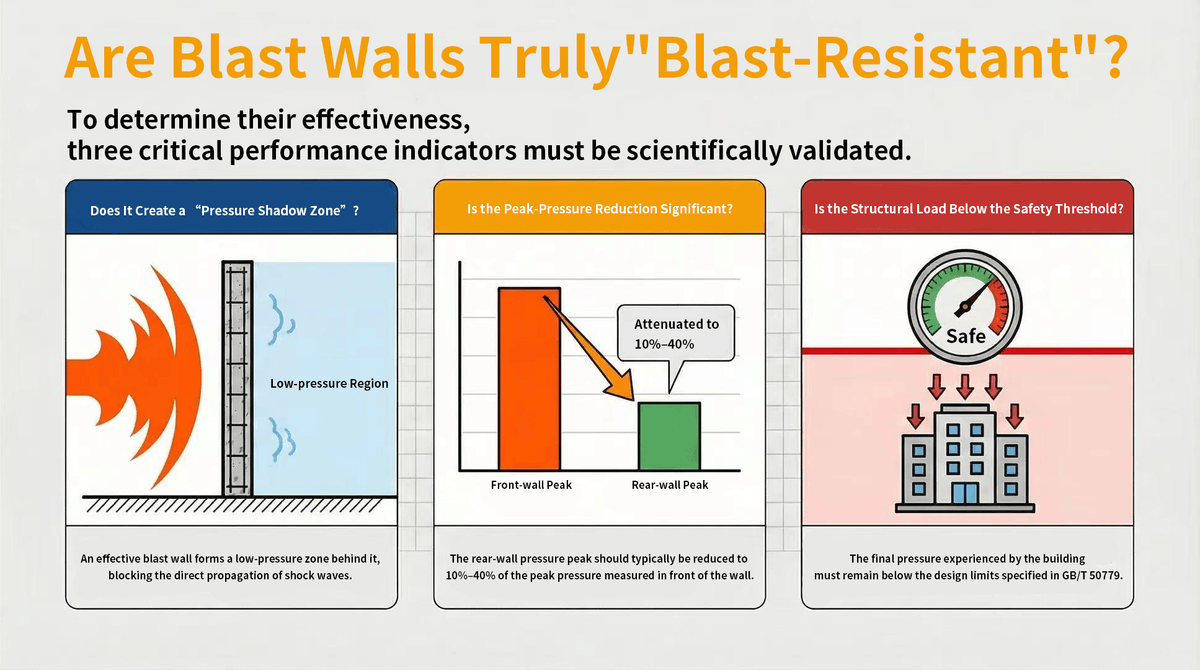
Q1|Does it create a “Pressure Shadow Zone”?
A low-pressure area behind the wall indicates effective blast shielding.
Q2|Is peak pressure significantly attenuated?
Industry reference:
Peak pressure behind the wall ≈ 10%–40% of the peak pressure in front
The stronger the attenuation, the better the isolation performance.
Q3|Does the building’s surface load meet national limits?
ExSim outputs final overpressure curves on the north, south, side walls, and roof.
Their peak values must meet the structural limits defined in GB/T 50779.
Only when all three criteria are satisfied can a blast wall be deemed truly effective.
04|Shanghai Tengxi: Making Blast-Resistance “Visible and Calculable”
We provide:
✔ National-standards-compliant blast-effectiveness evaluation
✔ High-accuracy CFD simulation based on DNV ExSim
✔ Professional technical reports for design institutes and review authorities
Engineering-grade blast protection—where every Pascal (Pa) is backed by data.